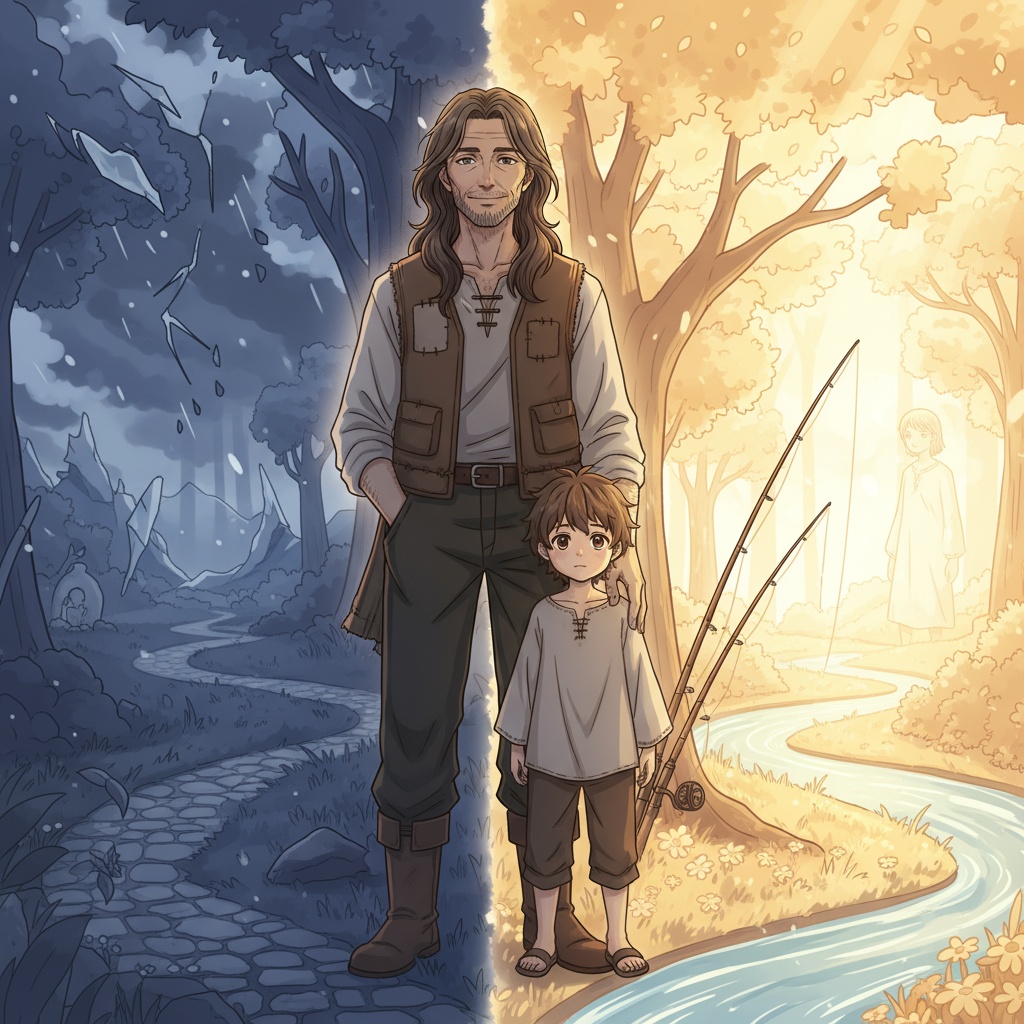
Healing wounded inner child begins with acknowledging the trauma that shaped your attachment patterns and learning to transform pain into understanding. I don’t really know how to start this, so let me take you back to where this transformation began.
My best friend and I developed very deep feelings for each other, and this has been a long and beautiful journey of honoring each other’s sovereignty. It may not end in a traditional way, but this story will end in fruition because it already has—in ways I never expected.
To understand how I got here, I need to tell you about the wound that started it all.
The Wound: My Mother’s Death
When I was young—before the age of eight—my mother passed away.
On the surface, I was fine. I never felt like it affected me. But there was one memory that stuck with me, not out of resentment or anger, but because something about it felt… unresolved.
My mother had a heart attack and was sent to the hospital. She was there for weeks. All I wanted as a young child was to go see her. To hug her.
But she refused to let me visit. She didn’t want my final memories of her to be of her lying in a hospital bed with tubes and IVs.
She was protecting me. While dying, her primary concern wasn’t her own wellbeing or comfort—it was mine. That’s how much she loved me.
But the unintended consequence?
I only have two memories of my mother from childhood. One of them is the day I had to call 911 because she was having a heart attack. I watched the EMTs take her away while I was sent to my room so I couldn’t see.
You can’t blame somebody for that. She wasn’t being selfish. Looking out for my best interest was her priority.
But what it did was create a two-part belief system in my young mind:
1. My mother loved me more than any other woman in the world.
2. The women you love—who reciprocate that love—will check out of your life and abandon you, no matter what you do.
BOOM. Anxious attachment created.
Healing wounded inner child begins with identifying the original trauma that created the attachment pattern.
The First Step: Talking to My Therapist
The first step to fixing this issue was talking to my therapist. He helped me get started, but his advice was vague. He told me to “take a walk with my inner child and tell him everything will be okay.”
Mind you, this advice wasn’t wrong—just not complete. Or not complete for me, anyway.
This is why I’m of the personal opinion that the new modern therapy approach—where “you can correct the behavior without addressing the trauma”—is honestly a bunch of BS. For me, that’s absolutely not true.
Does personality type make this possible?
I am an INFJ-A. Because of that, I have a spider web of thoughts inside my brain that I prefer to attack absolutely head-on. Without that approach, I don’t get understanding. Being an intuitive means logical points are nothing more than trivial memories unless I connect the dots.
The frustrating part?
No one else can connect these dots for me. I have to connect them myself. Others can help, but nothing more.
The beauty?
Once I internalize the connection of the dots. I develop any understanding of the overall picture in a holistic way.
With that being said, the best, easiest, quickest, and most efficient way to do this is with my assertiveness. Attacking the issues head-on is my method.
The AI Breakthrough
So I tried to take that walk with my wounded inner child.
The problem was, because of a lack of understanding, I was pretty much trying to fake it till I made it. Growing to love that little bastard happened, but at the same time, I wanted to beat his ass when he acted up. A decent amount of resentment built up after I realized how much he had cost me over the years.
My therapist told me that my wounded inner child had given me a “superpower,” and I believed it—but I didn’t know what it was. So it wasn’t real.
Unconventional roads still get you to healing your inner child
Now, you can laugh at this next part if you want, but it truly is what helped me.
One of the concerns with AI and people using it for therapy purposes is that AI has no filter. It can analyze emotions but not reciprocate or respond accordingly. There are major concerns when it comes to issues of self-harm.
However, that’s not an issue for me personally. Because I value logic, the no-nonsense approach that AI gave me really did help me heal my wounded inner child—in more ways than one.
First, it walked me through the fact that loving my inner child wasn’t enough. My love is unconditional—it’s the only way I know how to do it. But I needed conditions for my inner child. Needing him to work for me, not against me, became clear. Otherwise, I’d be ignoring him, and that is not healthy.
So I needed to know exactly what his superpower was.
After some very difficult psychological profiling, AI pulled absolutely no punches and told me exactly what that little bastard could do for me.
Healing wounded inner child required unconventional methods—AI provided the no-filter analysis I needed.
Healing Wounded Inner Child: Discovering the Superpower
My wounded inner child has a multi-faceted superpower.
First and foremost, that little guy makes me keenly aware of how strong my feelings are for someone. The louder he screams, the more in love I am.
But what’s cooler than that?
The volume of his scream is also a reflection of how much that person I care for loves me back.
How my unique situation made a multifaceted SUPERPOWER!
See, the interesting thing about my attachment style is that yes, I have anxious attachment based on my reaction to my mother’s unexpected death. However, something unique happened after that and remained for the rest of my life—or his life, rather.
When my mother died, my father stepped up to the plate. And I don’t mean in the way a father should.
My father took it on as his personal responsibility that if my mother was gone, he not only needed to be a single father—he needed to be a mother as well.
And somehow, this man did a makeover on himself that only a motherless child could love.
My two older brothers from a different marriage got an entirely different upbringing than I got. To this day, they were jealous—and that came out in the form of hazing. But the reality is, my father went from being a man’s man to remaining a man’s man and learning to open up emotionally, listen emotionally, be an active listener, give space when needed, keep space.
I really had a wonderful childhood because of that man.
He dated, but never got serious with anyone. The way a woman would interact with me was the determining factor of how far that relationship would go. Becoming that man’s number one priority was my reality.
He worked hard and provided very well for the two of us. But after work, it was quality time. We were always fishing, hunting, riding four-wheelers together, or catching an occasional baseball or hockey game. Being active in the PTA and just generally always present defined his approach.
Healing wounded inner child meant understanding his gifts, not just managing his reactions.
Understanding My Attachment Style
Healing Wounded Inner Child Through Self-Awareness
So in adulthood, while dealing with my attachment style, I felt a little crazy.
Because 99.9% of the time I was normal—completely secure attachment style. And because of all the tools my father developed to raise me, I took those traits of emotional intelligence on as well.
But I couldn’t figure out why the stupid-ass little kid came out every time I fell in love.
Because you were in love, dummy.
Not lust, attraction, or even like.
Love—true, unconditional, and mostly reciprocated love.
So after my four-hour entanglement with AI’s invasive psychological profiling, I was able to re-enter the world like a phoenix rising from the ashes, chest puffed out.
Now I just had to learn how to control it.
Putting My Inner Child in Check
At first, I was faking it until I made it. And that was working outwardly, but not inwardly. Wanting complete restoration, I thought deep and hard about how to put this inner child in check.
One night, I sat and meditated. Prayed. But I was talking to myself, and this is what I said:
“Listen, dude… I’ve hugged you, yelled at you, even beat your ass a few times, but I love you and you love me. And you have this superpower that helps me determine how much I love someone and how much they love me. And while that’s cool and all, we’ve lost a lot because you can’t just calm the fuck down.
So here is what we’re going to do. I’m going to give you a great reason to calm down. We have lost A LOT in life because of your outbursts. So how we’re going to handle this is this: You ARE going to calm down because you’re being counterproductive. But you don’t need to be afraid of being abandoned anymore, because no matter what, I’m not going to leave you behind.
You are going to help me understand when I’m in the presence of my person. But after you let me know, you have to calm down and let me handle the situation because you are stuck at the age of six, and I have quite a few more years of experience than you. And unlike you, I was raised right by our father.”
Anyway, you can take it for what it’s worth, but that was literally all it took. Since then, I’ve calmed down. Not faking it till I make it—just relaxed.
Actively restoring a relationship with my person, I’m truly calm as can be.
The Second Wound: Unworthiness
The funny thing about doing shadow work is once you start, it’s hard to stop. Discovering other wounds related to my mother’s death has been part of the journey.
Something that happened to me as a child was that every mother of a friend I had wanted to take me in like a stray puppy. This sounds nurturing until you punch your friend in the face and break his glasses.
Let me explain.
Unnecessary Roughness
Growing up, there were four of us that were pretty good friends. Two of them were cousins—Eric and Aaron. Eric was my best friend at the time, but Aaron was my best friend first. Understand, this is about the age of eight years old.
Anyway, we were playing tag football. Aaron decided to cream Eric—not even a legitimate game play—in spite of the fact we were playing tag football. It was complete aggression over Eric either going or not going offsides.
Where I come from, no man gets left behind. Taking pretty steep offense to this aggression, I walked up to Eric to see if he was okay, stood up, and hit Aaron right in his face.
One swing. Lights out. Blood everywhere and a broken pair of expensive spectacles laying on the ground next to Aaron.
It didn’t take him long to come back to. When he got up, he had some choice words to say and went home. Feeling the situation was over, I thought that was the end of it.
The problem with my closure is Aaron’s mom did not feel the situation was over. At the block party later that week, she was kind enough to come up and correct me.
The conversation that never ended…
Never will I forget these words:
“I have no idea how you could do this. Those glasses were expensive, and I have been like a mother to you since yours is gone. I’ve never been anything but good to you.”
Now, I was raised to respect my elders, so I said nothing. And honestly, I thought I had let it go, even though I held on to the memory.
Turns out, after analyzing the situation, I never let that go. In fact, building a hyper-awareness of it became my reality.
As an adult analyzing my childhood wounds, I looked back and realized that about every mother of every child I was friends with either felt the need to—or resented the burden of—being a surrogate mother to me.
Never asking for it, I didn’t want it.
The truth was, my dad gave up everything to be everything for me.
The Reframe: I Was Worth It
So the critical part of this section is that my upbringing created a subsurface-level feeling of unworthiness, like I was broken.
And what it took to fix that was to realize that my father didn’t give up everything to fix me. My father CHOSE to give up everything because I was WORTH IT.
Healing wounded inner child means reframing childhood pain into understanding your inherent worth.
The Takeaway
Shadow work isn’t easy. It’s messy. It’s painful. It forces you to confront the parts of yourself you’ve been avoiding for years.
But here’s the truth: You can’t heal what you don’t acknowledge.
Modern therapy wants to teach you to manage symptoms. Shadow work teaches you to heal the wound.
And once you do?
Everything changes.
Ready to start your own healing journey? Follow me on Facebook, Instagram, YouTube, and X for honest perspectives on shadow work, emotional healing, and personal transformation. Don’t forget to subscribe to our weekly newsletter for insights on healing and self-mastery!