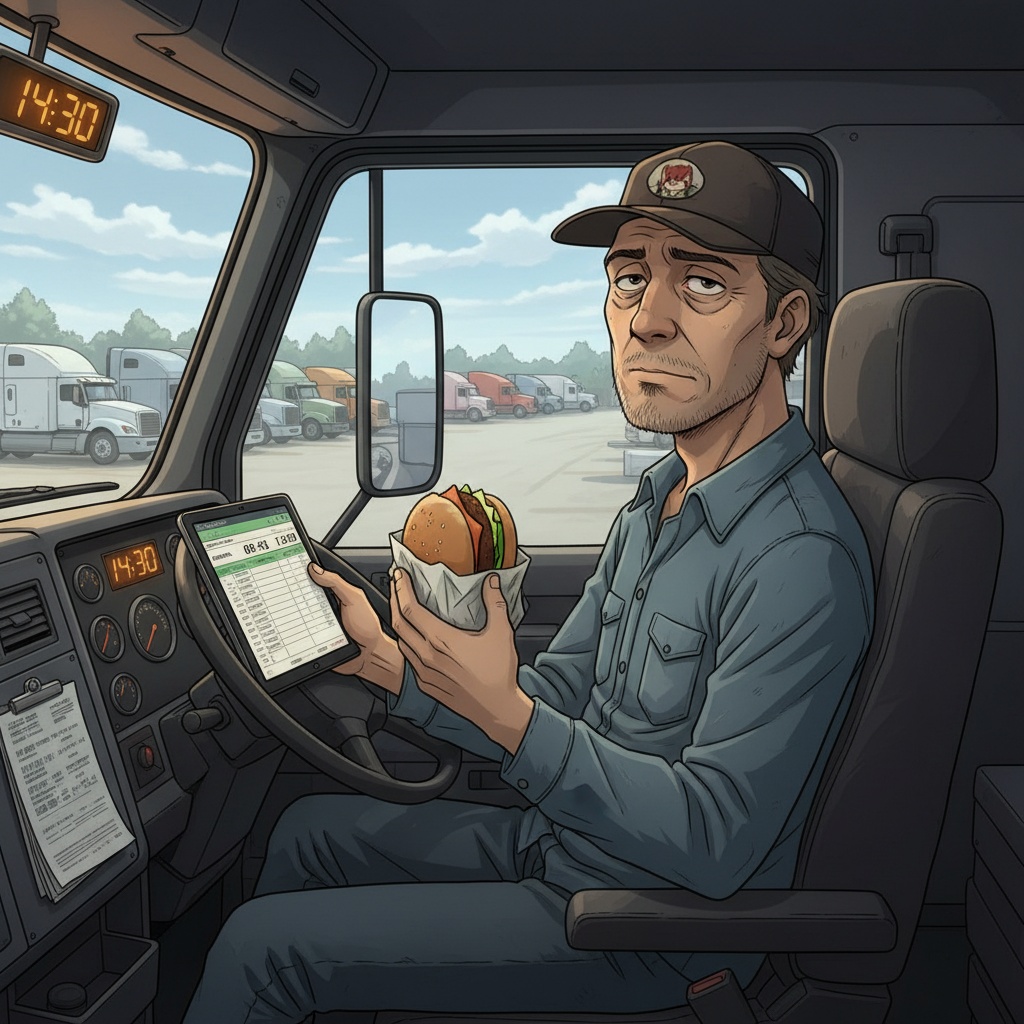
Trucking labor laws are fundamentally different from every other industry in America—and understanding why, could be the key to protecting your career and your paycheck. I’m driving down I-85 South in South Carolina, headed to Georgia, and I need to talk about something that’s been weighing on me.
I might be a little overworked at the moment. I’ll be honest about that.
I drive five days a week. I have two days off. On my first day off, I run my landscaping company—18 customers, nine one week, nine the other. That’s a full day’s work.
My brother, who does commercial landscaping as his main income, recently lost an employee. The way his business is structured, losing that employee put him in jeopardy of losing contracts.
I don’t know about you, but where I come from… you don’t, not help family. When there’s something you can do to help a family member, you help them.
Therefore, for the last three weeks, I’ve driven this truck all week, come home on my first day off, mowed all my lawns, and then spent that night and the following day helping my brother catch up on his work.
I am not exaggerating: I’ve put in at least one 20-hour day every weekend for the last three weeks.
I’m beat.
The Blah Days Every Trucker Knows
As truck drivers, we all get a little over things now and again. However, it’s not always the dramatic stuff—the four-wheeler who cut you off, the shipper who didn’t load you fast enough. Those make good stories, but more often than not, we just have days where we don’t want to move.
Everyone has that blah day where you can’t get out of bed and get that truck rolling.
One thing I noticed very early in my career: when those days happen, it’s always one of two things. Always.
Either I need a shower and didn’t realize it, or I need food.
One of my very first trainers used to preach: “Out here, you have to do what makes you happy. Otherwise, you won’t make it.”
Today, I decided I was going to get some Wendy’s. I pulled into a Pilot in South Carolina, went in, got a double cheeseburger, scrolled on social media a little bit, got a shower, and now I’m back on the road—ready to roll and get these next three days finished.
Nevertheless, while I was eating, I started thinking about something bigger.
Why We Even Have to Ask This Question
Why do truck drivers have to find these little moments of self-care just to keep going? Furthermore, why are we all running on fumes, overworked, and just trying to make it to the next reset?
Trucking is one of the only industries in this country where employers do not have to follow traditional trucking labor laws.
The FMCSA governs everything in trucking. Because we fall under the FMCSA, traditional labor laws don’t apply to truck drivers. Consequently, most truck drivers don’t receive overtime pay. Most don’t even know what overtime is.
Additionally, the ones who do receive hourly pay don’t know what compensation they’re getting because companies don’t have to pay hourly, and they don’t have to pay overtime after 40 hours.
The Trucking Overtime Exemption Problem
Some people receive time and a half after 40 hours in a week. In contrast, others receive it after eight hours in a day. Some receive double time. However, the trucking industry? We never got anything like that.
It’s not uniform or standard. Some people receive a percentage of the load as payment. Meanwhile, others receive payment per activity. Some receive payment by the mile. Others are on straight salary. Some receive all different combinations.
In general, we’re compensated pretty well. We do have higher earning potential compared to many other industries. Nevertheless, if you break it down hourly, it can tell a different story. Most of us find that our earning potential is offset by the sheer amount of hours we work.
Understanding trucking labor laws becomes critical to your financial future here.
The Two Bills That Could Change Everything
Right now, there are two pieces of legislation moving through Congress that could fundamentally change trucking labor laws and how the industry operates. Moreover, they’re moving in completely opposite directions.
The GOT Act: Changing Trucking Labor Laws
This is a bipartisan bill (S.893) that would:
- Remove the FLSA overtime exemption for truck drivers
- Require motor carriers to pay overtime after 40 hours per week
- Bring truckers UNDER traditional labor protections for the first time
I like the idea of receiving overtime pay. However, I’m not hopeful it will happen.
Why? It benefits drivers and the economy at the cost of businesses. Historically, when legislation helps workers at the expense of corporations, it doesn’t pass.
The Split Duty Period: New Trucking Labor Laws?
The FMCSA just announced a pilot program that would allow drivers to pause their 14-hour driving window for 30 minutes to 3 hours.
Currently, once you start your 14-hour clock, it runs continuously—you can’t stop it. This would give drivers flexibility to rest during traffic, bad weather, or wait times without burning their clock.
Sounds good, right?
Nevertheless, drivers are right to be worried.
Why HOS Changes Won’t Fix Trucking Labor Laws
The drivers who support it? That’s what bothers me. It’s a lack of value for their own time and indoctrination into the idea that trucking is a lifestyle. All they see is more money. They don’t see the energy they’ll give up to make that extra money.
In reality, it likely won’t be much money for them in the first place.
This bill benefits the economy and the businesses. Not the drivers.
The Trucking Labor Laws Scam Nobody’s Talking About
Here’s what really bothers me: the timing seems like a scam perpetrated by the current administration.
They’re deporting or delicensing a lot of non-English speaking drivers. This means freight will still need moving, but there will be fewer drivers to move it.
Both of these bills help solve that problem. However, only one helps drivers.
The HOS flexibility bill lets companies squeeze more work out of fewer drivers. In contrast, the GOT Act would force companies to actually compensate drivers fairly for the extra hours.
Guess which one has more support from the industry?
The Old Guard Mentality About Trucking Labor Laws
Old-timers will directly tell you: “You’re never going to get paid for everything you do in this truck.”
Why? Why is that acceptable?
A secretary who receives hourly pay gets compensation for every minute she’s on that phone. Every keystroke she types. Every minute she’s at that desk. She receives payment for everything.
Why do we accept a job where people tell us, “You’re not going to get paid for all your time”?
Why do truck drivers accept not receiving payment for everything they do?
I’ve never understood it.
The Contradictions in Trucking Culture
When you hear the old-timers—especially owner-operators—complain that they can’t make a living because freight rates are dropping, and then in the same breath say “you’ll never get paid for everything you do,” it’s contradictory.
Meanwhile, new drivers are complaining that they want to be home more. They want their time respected. They want nicer equipment. They want all these things.
The biggest thing I hear them say is: “I want to be paid what I’m worth. I want the respect that I deserve.”
Here’s the thing about respect: it’s a two-way street.
If You Don’t Value Your Time, Nobody Else Will
Make no mistake about it—I love what I do. I work for a company that pays us very, very well. I do happen to receive payment for everything I do. I have a rate per mile for driving. I have activity pay for dropping and hooking. I have an hourly rate when I’m detained.
I receive compensation for the things I do, and I’m happy.
That’s not the same story for everybody.
If drivers were having a real conversation, a lot of them would say they want respect, they want to be home more, they want more money.
Here’s the reality about respect: it’s a two-way street, and you negotiate what you receive.
When you agree to subpar pay, when you agree to work for free, why should you expect someone else to value your time more than you value it yourself? And when the powers that be see you not respecting your time… Believe me it’s viewed as an overall lack of self-respect.
This connects directly to understanding trucking labor laws and knowing your rights under current regulations.
The Energy You’ll Never Get Back
This ties back to something I’ve written about before: money is energy.
When you give up your time—your energy—for subpar compensation, you’re not just losing money. You’re losing the ability to compound that energy into something greater.
Every hour you work for free is an hour you can’t get back. Additionally, every reset you spend exhausted in a truck stop because you pushed too hard is energy you’ll never recover.
The HOS flexibility bill looks like freedom, but companies really just use it as a way to extract more energy from drivers without compensating them for it.
In contrast, the GOT Act would force companies to actually pay for that energy.
I’m not holding my breath.
What Do You Do on Blah Days?
So I’m back to my original question: What do you do out here when you’re having a blah day?
Do you suck it up and chalk it up as a loss? Do you shut down early and try again tomorrow? Do you go get yourself a meal of junk food? Hop on the Highway Hustle Facebook group and vent to like-minded drivers?
Here’s the reality: we’re navigating an industry built on exemptions from labor protections. Furthermore, we’re doing it in a time when the system is about to change—either in our favor or against us.
We’re doing it while people tell us that we should just accept not receiving payment for all our time.
Protecting Your Energy and Your Future
One of my trainers told me: “You have to do what makes you happy out here. Otherwise, you won’t make it.”
For me today, that was a burger and a shower.
Long-term? It’s about protecting my energy. Valuing my time. Not falling for the idea that more flexibility means more freedom when it really just means more work for the same pay.
Understanding trucking labor laws and how current trucking labor laws affect your paycheck is the first step toward demanding fair compensation. Your body won’t last forever. Therefore, start protecting your energy—and demanding fair compensation for it—while you still can.
Ready to join drivers who understand their worth? Follow me on Facebook, Instagram, YouTube, and X for honest talk about trucking pay, labor rights, and protecting your career. Don’t forget to subscribe to our weekly newsletter for insider insights on trucking legislation and driver advocacy!